
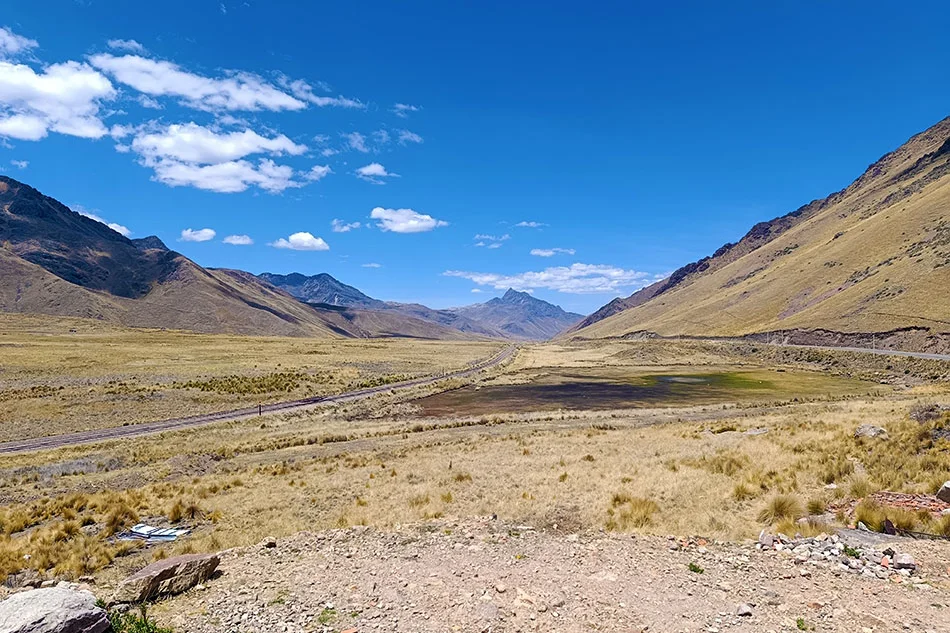
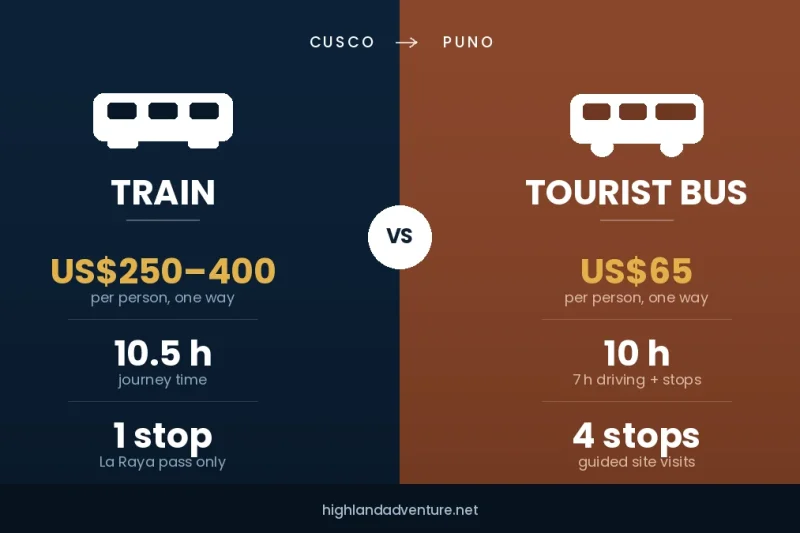
Both cover the same 385 kilometres between Cusco and Puno. Both take about ten hours. One costs six to ten times more than the other.
That is the entire decision, and the right answer depends on one question: is the journey part of your trip, or the gap between the parts of your trip?
Side by side
| Titicaca train | Tourist bus | |
|---|---|---|
| Price | US$250–400 | US$25–70 |
| Duration | ~10.5 hours | ~10 hours |
| Frequency | ~3 times a week, seasonal | Daily |
| Stops | La Raya pass only | 4–5 sites you get out and visit |
| Meals | Three-course lunch included | Buffet lunch, usually included |
| Guide | On-board hosts, no site guiding | Guide at each archaeological stop |
| Comfort | Very high — space, dining car, open deck | Good — reclining seats, on and off all day |
| Scenery | Uninterrupted, from a moving lounge | Same landscape, seen from the road |
| Booking window | 1–2 months in high season | A few days ahead is usually fine |
What each one is actually for
The train is a day out
You are buying a slow, comfortable, well-fed day with nothing to organise. Panoramic windows, an open-air observation car at the back, live music, a proper lunch, and one stop at La Raya pass at 4,335 metres.
What it does not do is show you anything you get out and walk around. The train passes the archaeological sites on this route without stopping at them.
The bus is a sightseeing day
The tourist bus — not the direct local service — stops at the sites strung along this road:
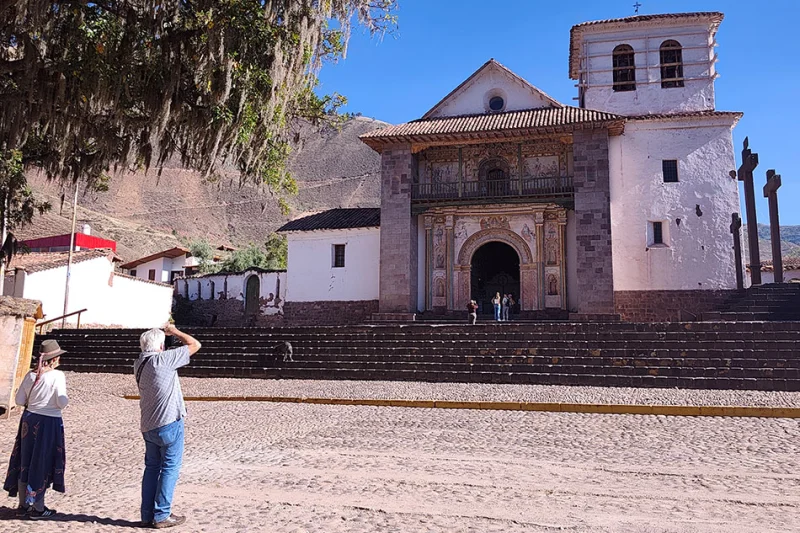
- Andahuaylillas — the colonial church often called the Sistine Chapel of the Andes
- Raqchi — the temple of Wiracocha, among the largest surviving Inca structures
- La Raya pass — the same 4,335 m viewpoint the train stops at
- Pukará — the pre-Inca site and its museum
You get out at each one with a guide. The transfer day becomes a full day of sightseeing that you would otherwise have paid for separately.
Choose the train if
- Rail journeys are something you enjoy in themselves
- The budget is not the constraint on your trip
- You want a genuinely restful day with meals handled
- Mobility, age or altitude makes getting on and off a bus all day unappealing
- Your dates happen to match one of the few weekly departures
Choose the bus if
- You want to see Raqchi and Andahuaylillas — the train does not stop there
- You would rather spend the difference on Lake Titicaca, which is why you are going to Puno
- Your dates are tight and you need daily departures
- You are travelling in the rainy season, when train service is reduced
- You are travelling as a family or group, where the price gap multiplies fast
The honest recommendation
We are based in Puno and see travellers arrive by both every week. For most people, the tourist bus is the better trip, not just the cheaper one — because it gives you four sites, a guide, and the same landscape, for a fraction of the cost.
The train earns its price for a specific traveller: someone for whom the railway journey is itself one of the things they came to Peru to do. If that is you, it delivers exactly what it promises and you will not regret it.
What we would gently push back on is taking the train because it seems like the premium choice by default. On this particular route, the cheaper option is not the compromise — it is the one with more in it.
A third option worth knowing
Neither the train nor a standard bus is the only way to spend this day. Our Pallay Punchu tour from Puno to Cusco uses the transfer to visit Pallay Punchu, a striped mountain with the same geology as Rainbow Mountain and almost none of its crowds. You arrive having actually done something, without spending a separate day on it.
Frequently asked questions
Is the train or bus better from Cusco to Puno?
The bus is better value and includes four guided archaeological stops. The train is more comfortable and a genuine scenic experience, at six to ten times the price. Neither is objectively better — they serve different purposes.
How much cheaper is the bus?
Substantially. A tourist bus costs roughly US$25 to US$70 against US$250 to US$400 for the train, for a journey of almost identical length.
Does the train stop at Raqchi or Andahuaylillas?
No. The train passes these sites but its only stop is at La Raya pass. If you want to visit them, take the tourist bus.
Is the bus safe and comfortable?
Tourist buses on this route are modern, with reclining seats, a guide and scheduled stops. They are a standard, well-established service used by most travellers between the two cities.
Which is faster?
Neither, in practice — both take about ten hours. A direct local bus without stops is faster at around seven hours, but you see nothing along the way.
Can I take the train one way and the bus the other?
Yes, and this is what most travellers who want the train experience actually do, since the train is sold one way only and runs just a few days a week.
Next steps
- Full Cusco to Puno train guide — schedules, route and what the journey is like
- Cusco to Puno train price — the full cost breakdown
- Cusco to Puno bus guide — companies, stops and booking
- Lake Titicaca tours — what you came to Puno for
No available comments