
Overview
The Pallay Punchu Tour from Puno to Cusco replaces a plain intercity transfer with a stop at one of the newest mountains on the southern Andes circuit. Departure is from Puno in the early hours, with the hike scheduled for late morning and arrival in Cusco by evening.
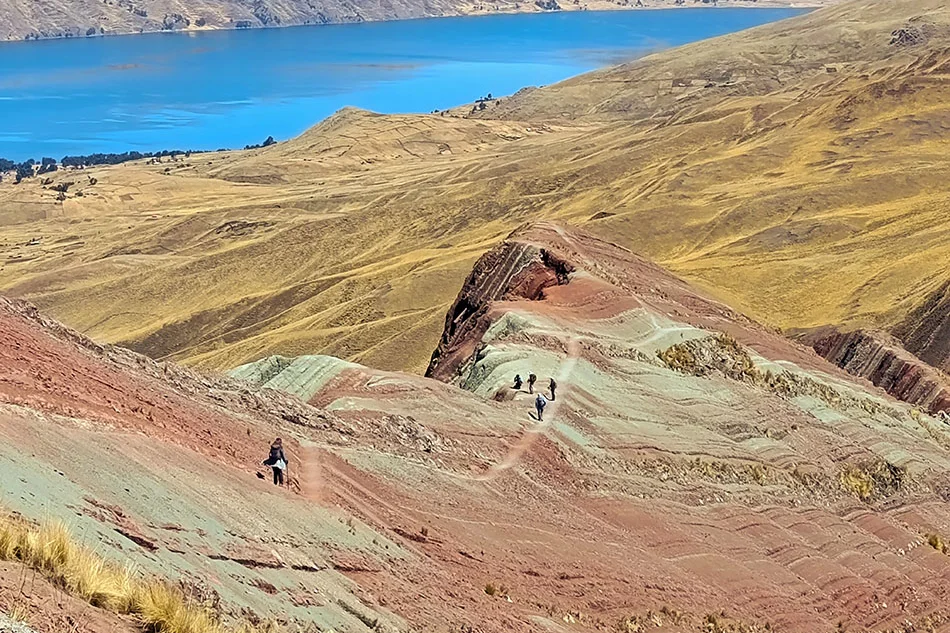
The full name of the site is Pallay Punchu de Apu T'acllo. In Quechua, pallay punchu means woven poncho, a reference to the sharp triangular ridges that fan out along the summit like folded cloth. Layers of red, grey, ochre and mustard run diagonally across the rock.
Unlike the rounded slopes of Vinicunca, this formation is angular. Wind and ice have carved the sandstone into a row of pointed fins, which is why photographers often prefer it in mid-morning light when the shadows sharpen the edges.
The route leaves Puno, skirts Juliaca and Ayaviri, then climbs to the La Raya pass at 4,338 m before dropping into the Cusco region. From Sicuani the road turns south toward Langui and Layo, in Canas province.
Just below the mountain sits Lake Langui-Layo, the largest body of water in the Cusco region at nearly 4,000 hectares. Its deep blue surface against the striped ridge is the view most travellers remember, and it is visible for almost the entire climb.
The trail itself is short. From the parking area at roughly 4,600 m, the walk covers about 1.5 km and takes 40 to 60 minutes at a steady pace. The final section is steep and loose underfoot, so hiking poles help more than they do on other Andean routes.
Layo is a herding district, and alpaca and sheep flocks graze right beside the path. Local families from the community manage the entrance and maintain the trail, so the fee paid at the base goes directly into the village.
Choosing the Pallay Punchu Tour from Puno to Cusco means covering roughly 380 km with a genuine mountain hike built into the day. Arrival in Cusco is normally around 19:00, leaving the following morning free for the Sacred Valley, Machu Picchu or Humantay Lake.